
The edge is where better design begins.
Design for the Edges means paying attention to the people most likely to experience friction in a system.
Not because they are the problem, but because their experience often reveals what the system needs to change.
Designing for the edge means starting where friction shows up first.
The edge is not one fixed group. It is wherever work becomes harder to access, understand or navigate because the system assumes one “normal” way of working.
The SENSA® approach treats that friction as useful information. It asks what the system can learn, rather than asking people to keep compensating for poor design.
Friction Appears
Someone struggles with a process, expectation or environment that others may not notice.
The System Learns
That friction is treated as useful information, not individual failure.
Work Is Redesigned
Small, practical changes reduce load and make the system easier to navigate.
Everyone Benefits
Clarity, consistency and accessibility improve across the wider organisation.
The edge is where the “default worker” assumption starts to break down.
Workplaces often assume a standard way of thinking, communicating, processing information, managing energy and organising life around work. The edge is where those assumptions stop working.
Neurodivergent People
Often experience friction first when communication is vague, sensory demands are high, or expectations rely on unwritten rules.
Disabled People and People with Health Conditions
Reveal where processes, environments and assumptions make access harder than it needs to be.
Carers and Parents
Expose systems built around constant availability, low flexibility and little recognition of life outside work.
People Working Across Cultures or Languages
Show where communication norms, confidence and professionalism are coded around one dominant style.
New Starters
Make visible the assumptions, shortcuts and “you just know” knowledge that established employees may no longer see.
People Experiencing Stress or Burnout
Show where pace, unpredictability or unclear expectations create avoidable pressure.
The edge is not the exception. The edge is where better design begins.
This is not a new fad. And it does not have to be expensive.
“Isn’t this just another inclusion trend?”
No. The principle has existed for years across universal design, inclusive design, accessibility, human-centred design and systems thinking.
The idea is simple: strengthen the point where the system is most likely to fail, and the whole system becomes more robust.
“Won’t this be expensive?”
Not necessarily. Many of the most effective changes are small, practical and low cost.
Clearer meeting agendas, written follow-ups, predictable onboarding, plain language policies and consistent adjustment processes can all reduce friction without major investment.
Design for the Edges is the philosophy. SENSA® is the method.
Design for the Edges explains why systems should be redesigned around the people most likely to experience friction.
SENSA® turns that philosophy into a practical framework for workplace neuroinclusion, helping organisations identify where systems create unnecessary friction and redesign them for greater clarity, consistency and inclusion.
Sustainable inclusion is not created by asking people to work harder. It is created by designing work better.
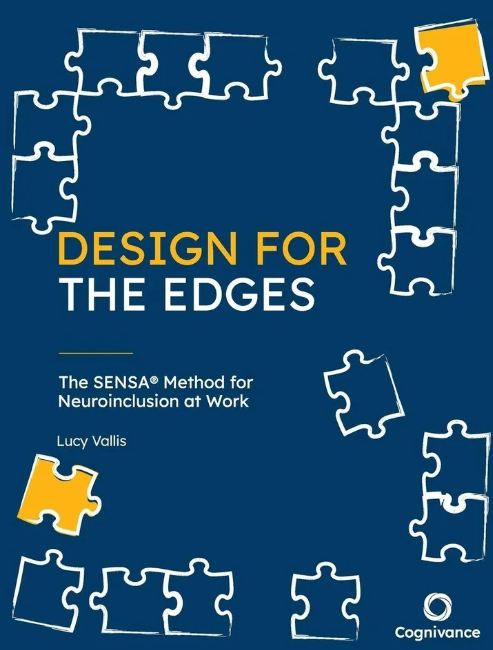
Design for the Edges
The SENSA® Method for Neuroinclusion at Work — Lucy Vallis
The intellectual foundation behind SENSA®. Design for the Edges argues that organisations work better when they are designed for the people most likely to experience friction within them.
Buy on AmazonReady to see where workplace friction is showing up?
SENSA® turns design-led neuroinclusion into practical, consistent workplace change.