

The Thinking Behind SENSA®
We Kept Seeing the Same Pattern.
Throughout our careers, organisations invested in awareness training. Managers genuinely wanted to do the right thing. Policies existed, guidance was available, and workplace adjustments were being made.
Yet neurodivergent employees often had very different experiences depending on who they worked for, which team they joined, or how confident a manager felt navigating a situation.
The problem wasn't a lack of commitment. It wasn't a lack of good intentions. Too often, inclusion depended on individual interpretation rather than consistent organisational practice.
SENSA® was created to help organisations bridge that gap. Rather than focusing solely on awareness, SENSA® helps organisations build neuro-inclusive practice into the systems, processes and decision-making structures that shape everyday work.
Why Awareness Alone Isn't Enough.
Organisations often approach inclusion through awareness and individual capability. While understanding matters, awareness alone does not determine how decisions are made across complex systems.
Workplace behaviour is shaped by structures — policies, workflows, reporting lines, performance expectations, and informal norms. When these systems are ambiguous, inconsistent application becomes inevitable.
Managers interpret differently.
Teams apply standards unevenly.
Inclusion becomes discretionary rather than dependable.
SENSA® reframes neuro-inclusion as a question of organisational design. Instead of asking individuals to compensate for unclear systems, it introduces structured frameworks that reduce ambiguity and support consistent decision-making.
When inclusion is designed into the system, it becomes repeatable — not dependent on personal interpretation.
The SENSA® Foundation
Together, these three principles help organisations move from informal effort to embedded practice — where neuro-inclusive thinking becomes part of everyday organisational life rather than a standalone initiative.
Structure
Clear frameworks reduce ambiguity and improve decision clarity across teams and management layers.
Consistency
Shared approaches reduce variability across teams and managerial layers — inclusion becomes dependable, not discretionary.
Capability
Internal practitioners build long-term organisational competence — sustained from within, not dependent on external support.
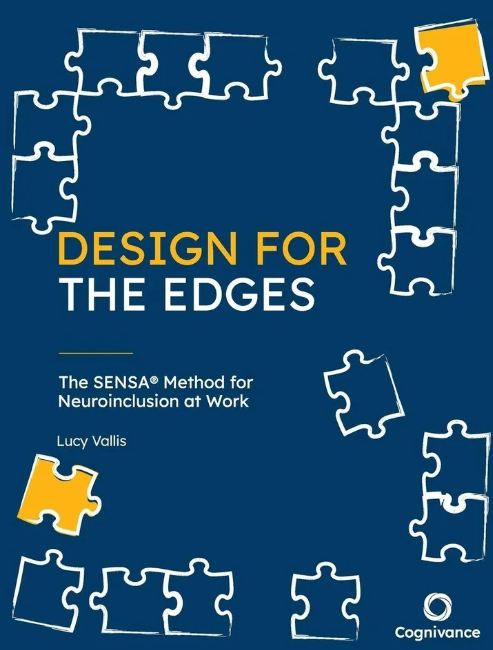
Design for the Edges
The SENSA® Method for Neuroinclusion at Work — Lucy Vallis
The intellectual foundation behind SENSA®. Design for the Edges argues that organisations work better when they are designed for the people most likely to experience friction within them — and provides a practical framework for making that happen.
Buy on AmazonThe People Behind SENSA®
SENSA® was developed by Lucy Vallis and Simon Walter through Cognivance Ltd, combining expertise in organisational change, workplace inclusion, neurodiversity, systems thinking and practical implementation.
Our focus is not awareness alone. It is helping organisations build the conditions in which inclusive practice can be delivered consistently, sustainably and at scale.

Lucy Vallis
Creator of SENSA® | Director, Cognivance Ltd
Lucy developed the SENSA® methodology drawing on twenty years of experience across central government, international NGOs and the charity sector. A senior leader and former CEO, she holds a degree in Applied Social Science, CIPD Level 5 Diploma, NEBOSH, IOSH and MHFA Instructor credentials. Lucy is neurodivergent with lived experience of ADHD, which is central to both her professional identity and the SENSA methodology. She has published two books — Design for the Edges and Violence Against Women at Work, published as part of the EU-funded Daphne Programme in 2010.

Simon Walter
Creator of SENSA® | Director, Cognivance Ltd
Simon brings 25 years of financial services experience to Cognivance, including a decade as Managing Director at Deutsche Bank. His background in complex decision-making, commercial leadership and organisational performance shapes how SENSA is structured, positioned and delivered to organisations. Simon leads external relationships and commercial development at Cognivance, ensuring SENSA reaches the organisations that need it most.